




The Day Book Module is one of the most important components of accounting and ERP systems. It records all daily financial transactions in a systematic and chronological manner, helping businesses and institutions maintain transparency, accuracy, and financial control.
Important Topics
Whether you run a school, college, business, or organization, a digital Day Book Module ensures that every receipt and payment is tracked properly, making accounting simple and audit-ready.
What Is a Day Book Module?
A Day Book Module is an accounting feature used to record day-to-day financial transactions such as cash receipts, payments, fees collected, expenses, and adjustments.
It acts as the primary book of accounts, where transactions are entered first before being posted to ledgers or reports.
In modern ERP systems, the Day Book Module is:
-
Automated
-
Real-time
-
Error-free
-
Integrated with accounting and finance modules
Stop Chasing Payments & Do Invest in Fee Management System
Importance of the Day Book Module
The Day Book Module plays a critical role in financial management. Below are the key reasons why it is important:
-
Daily Financial Tracking
It provides a clear picture of all transactions that occur on a particular day, helping organizations monitor cash flow effectively.
-
Transparency & Accountability
Every transaction is recorded with date, description, amount, and payment mode, ensuring complete transparency.
-
Audit & Compliance Support
Day books are essential during audits as they serve as a verified source of daily financial activity.
-
Error Reduction
Automated calculations reduce manual errors that are common in traditional accounting methods.
-
Decision-Making Support
Accurate daily financial data helps management take informed financial decisions.

Types of Day Book
Depending on organizational needs, Day Books are classified into different types:
1. Cash Day Book
Records all cash receipts and cash payments made during the day.
Example:
-
Fees collected in cash
-
Cash expenses
-
Petty cash transactions
2. Bank Day Book
Maintains records of bank-related transactions, including:
-
Cheque payments
-
Online transfers
-
Bank deposits
-
Withdrawals
3. Combined Day Book
Includes both cash and bank transactions in a single book, commonly used in ERP systems.
4. Fee Day Book (Education Sector)
Used by schools and colleges to track:
-
Student fee collection
-
Fee refunds
-
Due fee adjustments
5. Expense Day Book
Tracks daily operational expenses such as:
-
Utilities
-
Maintenance
-
Salaries
-
Office purchases
ERP-Based Digital Day Book Format
In ERP systems, the Day Book includes:
-
Date & time
-
Transaction type
-
Reference number
-
Payment mode (Cash / Bank / Online)
-
Amount
-
Auto-calculated balance
This format is dynamic, filterable, and exportable.
Daybook Format on Vedmarg
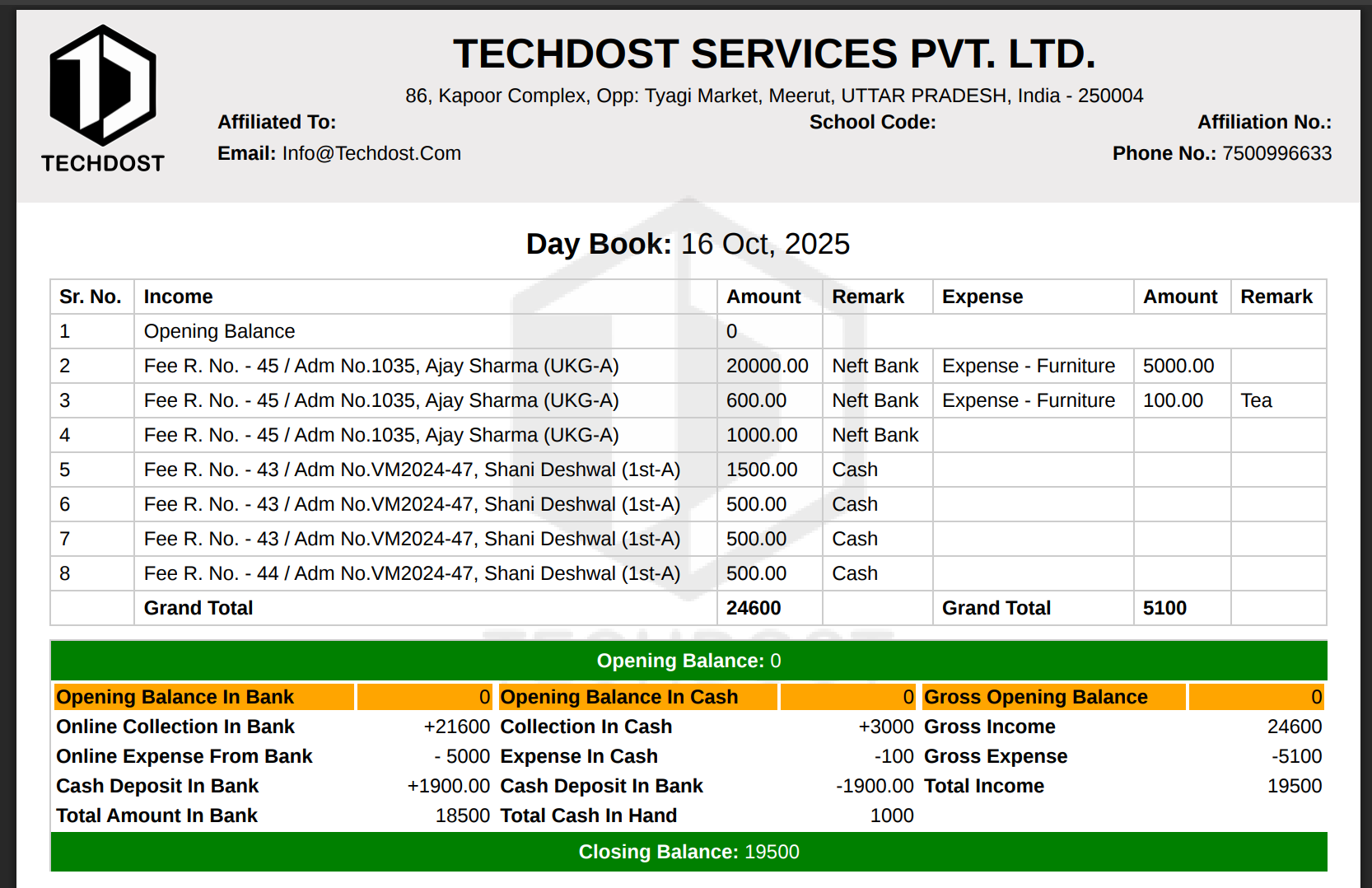
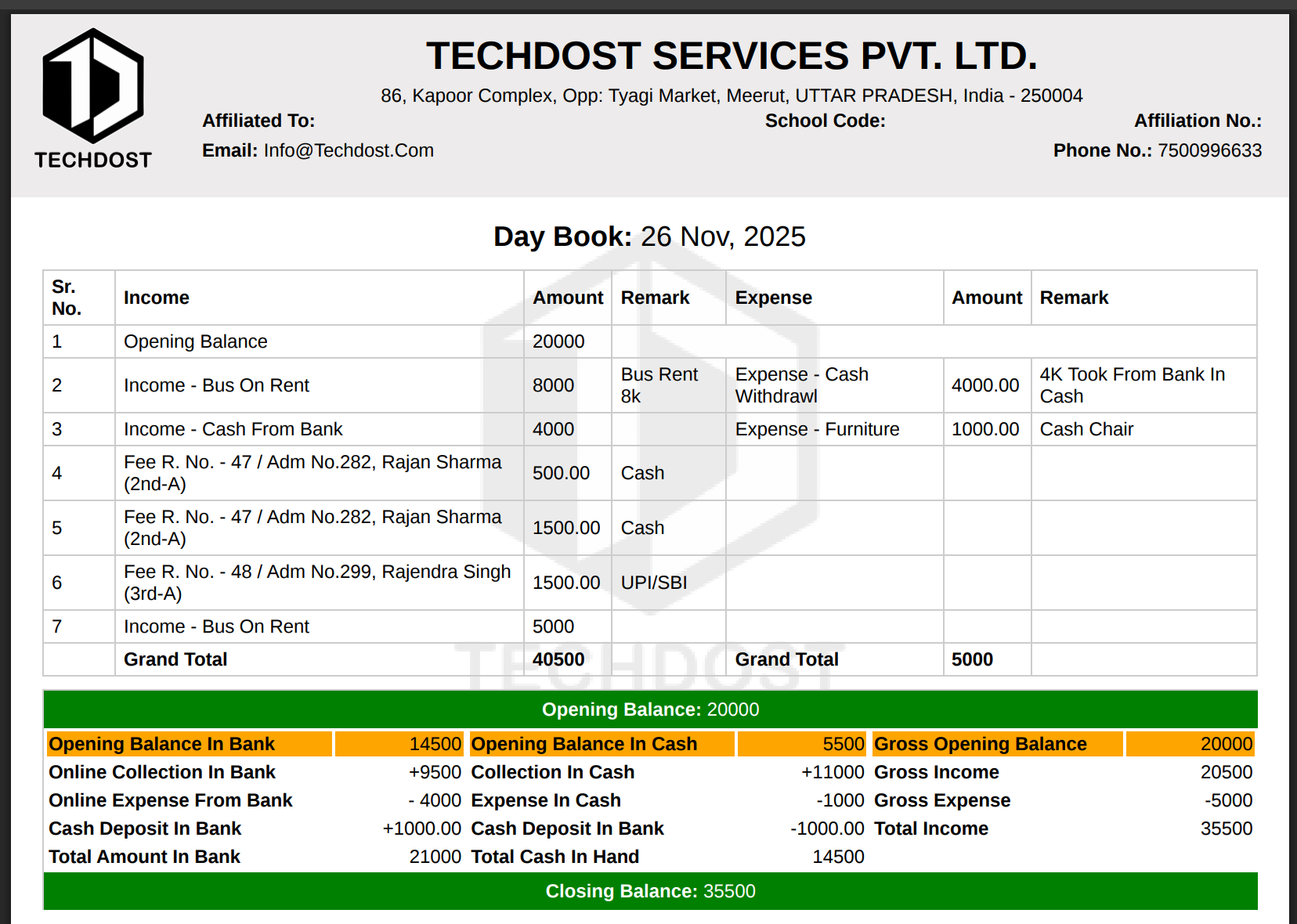
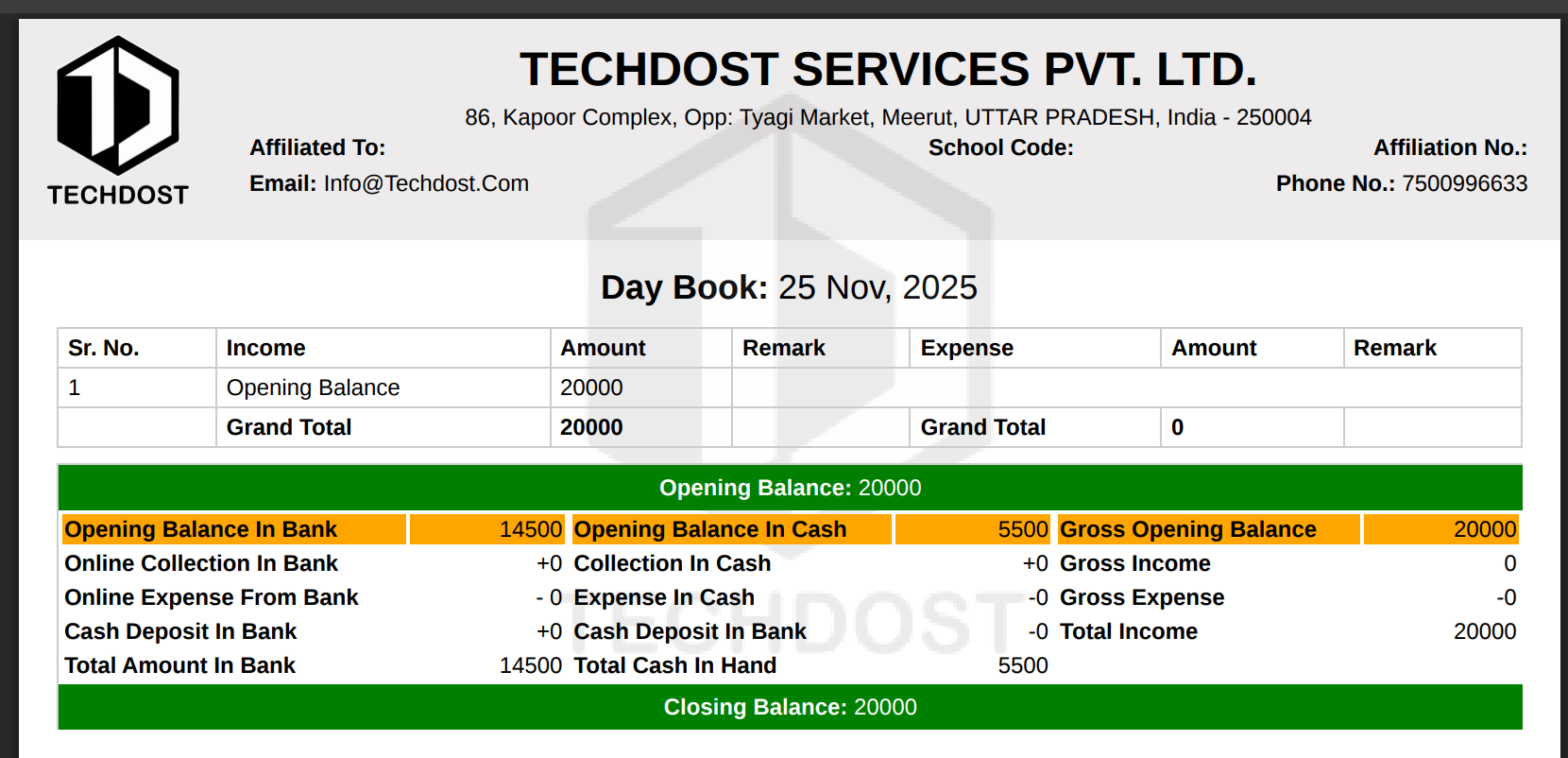
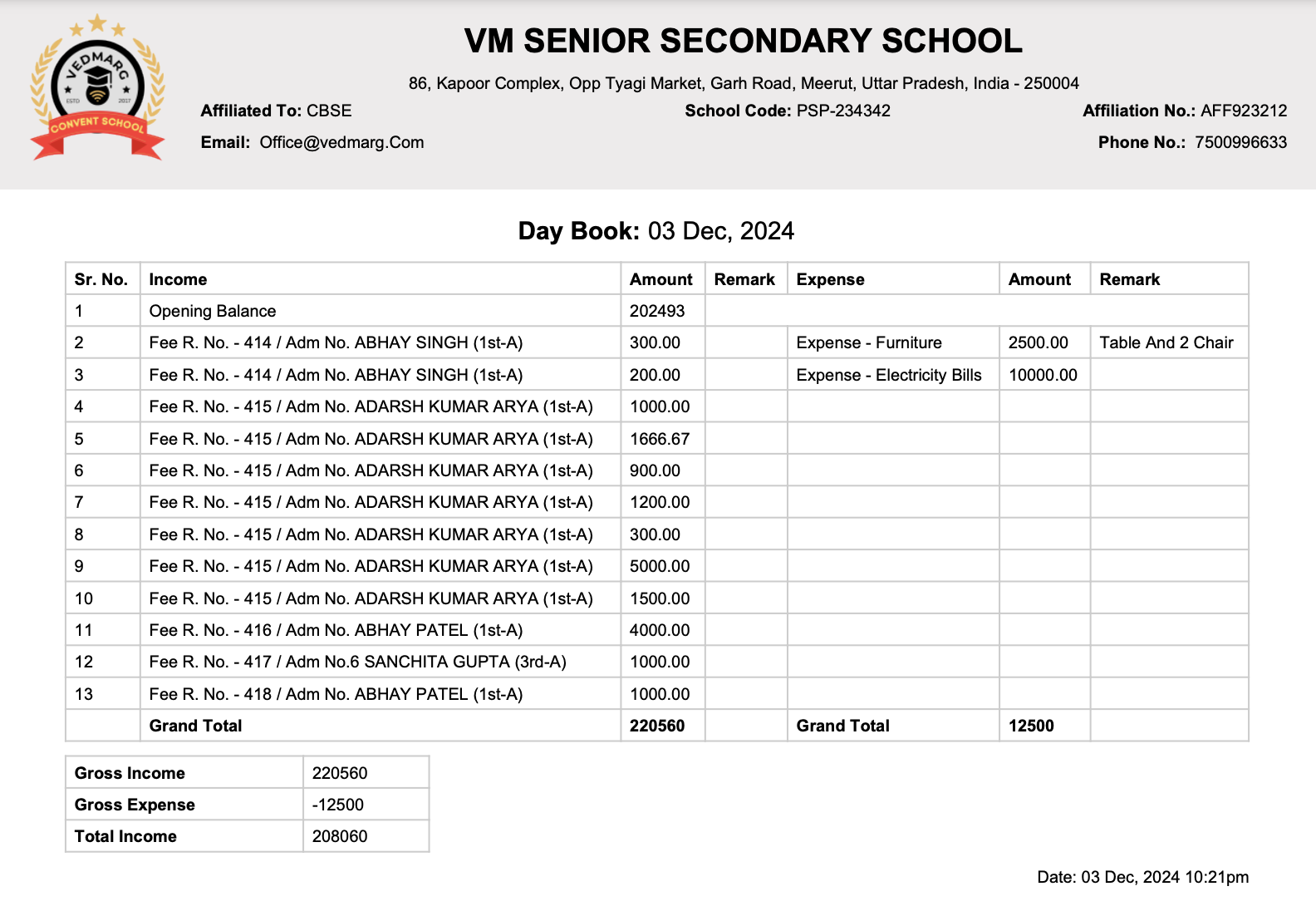
A typical daybook entry includes:
- Sr No. – Simple serial number
- Income particulars: It has opening balance, income from fee collection, and income from extra sources (extra income module)
- Income Amount: Amount of fee collection of extra income
- Remark: Remarks mentioned with the fee collection and extra income entries
- Date: Transaction date of entries
- Expense Particulars: Entries from expenses
- Expense Amount: Amount of the expenses
- Remark of Expenses: Remarks mentioned with the expenses
- Grand Total: It is showing the grand total amount that is “income – expenses = grand total”
Note: If the grand total amount is positive, the organization is in profit for the same day and if the amount is negative (like -15,450), the organisation has a loss.
How To Download, Print Day Book on Vedmarg School ERP Software
- First of all, you must have the permission of day book module on Vedmarg school erp software.
- Head to ledger and then find the day book option there, click on day book option (direct link: https://account.vedmarg.com/user/daybook)
- Now, you can select the date and click on print or download button as per your requirement (see image below).
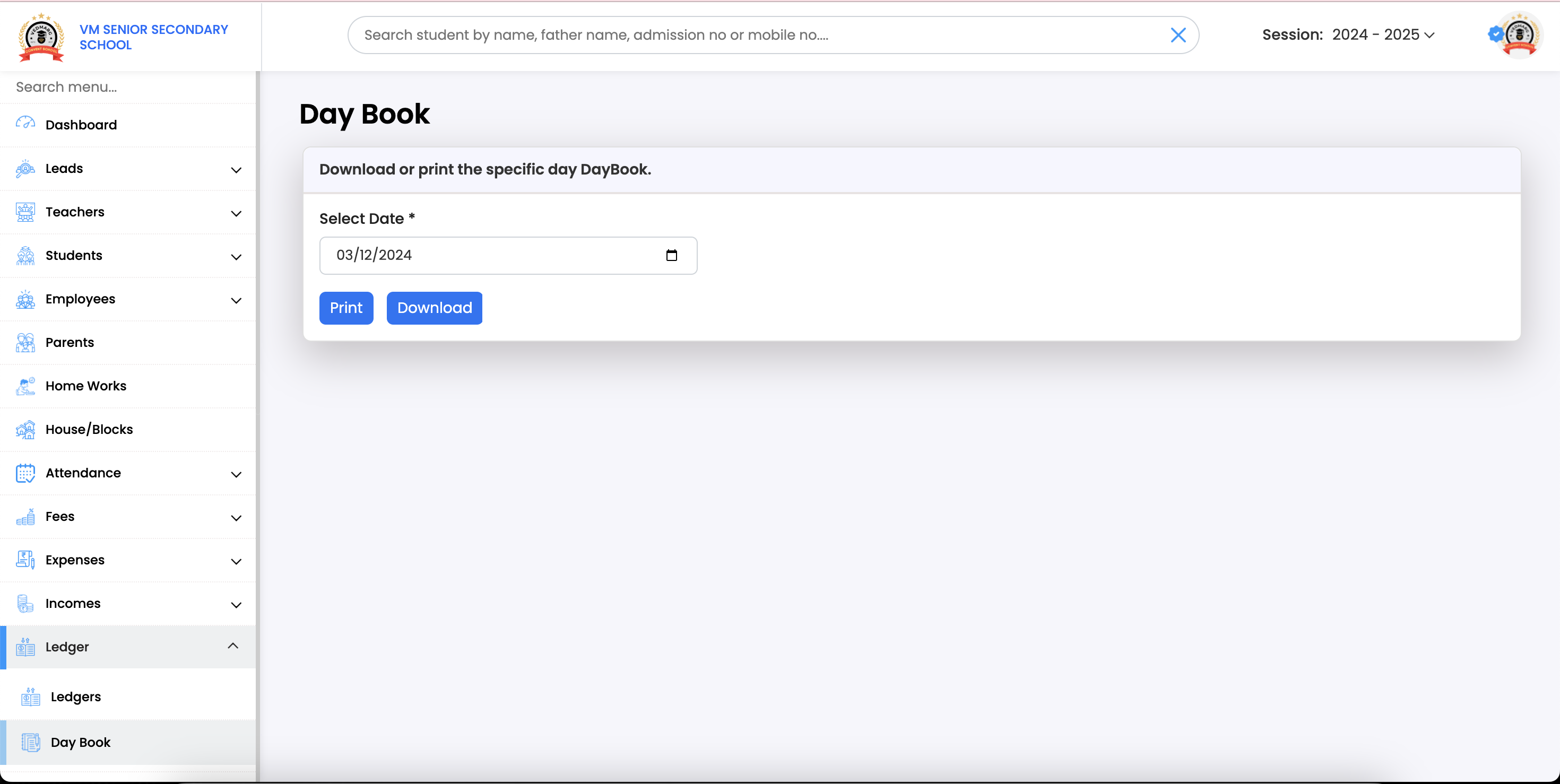
After clicking the button, you will get your required pdf file on your screen.
Day Book Sample of Vedmarg ERP Software
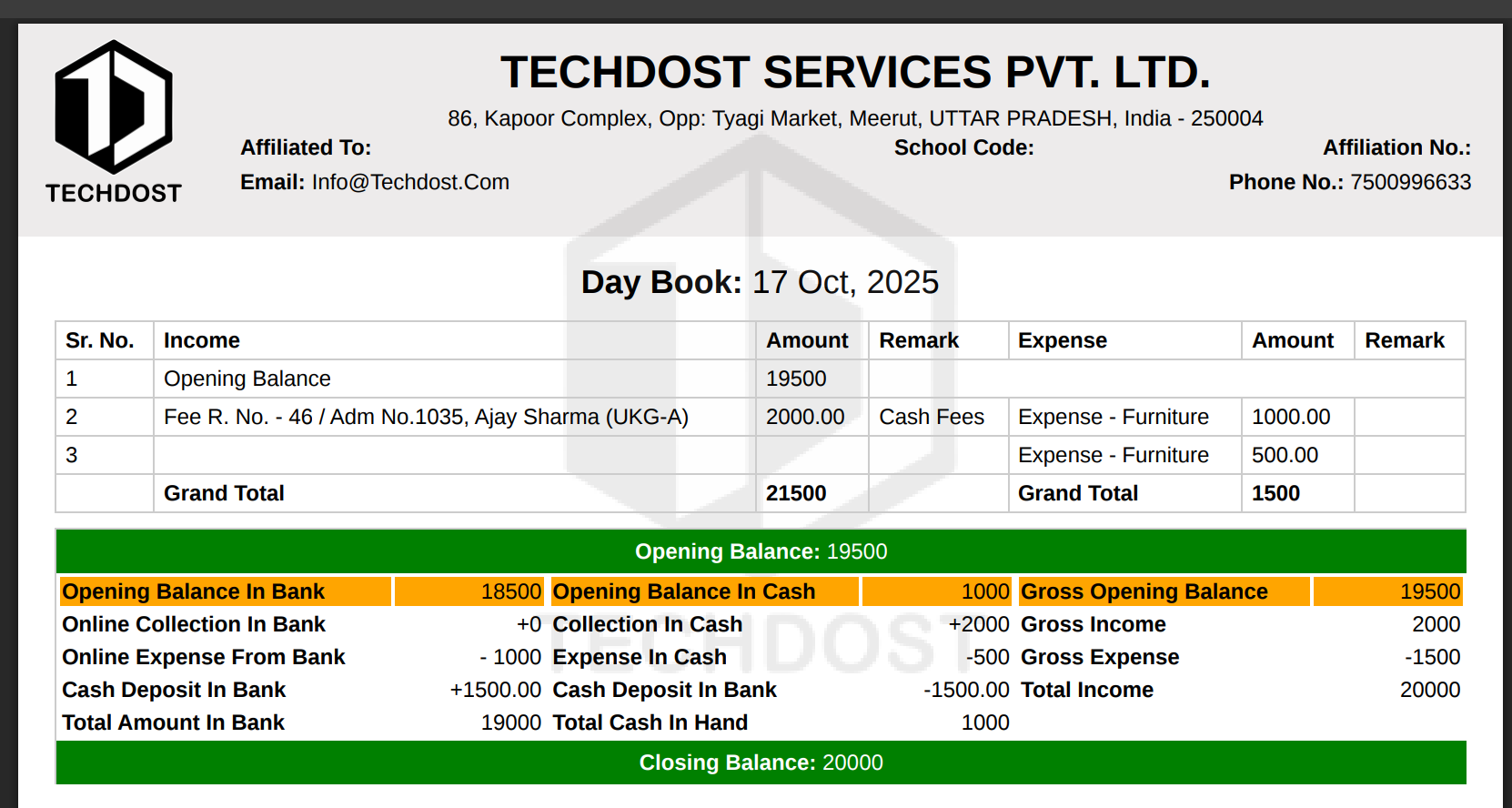
Old Format of Day Book in Vedmarg ERP
Benefits of Using a Digital Day Book Module
Switching from manual to digital Day Book offers several advantages:
-
Real-time transaction updates
-
Automatic balance calculation
-
Easy filtering by date, type, or account
-
Secure data storage
-
Instant report generation
-
Reduced paperwork
This makes the Day Book Module essential in modern ERP systems.
Who Should Use the Day Book Module?
The Day Book Module is useful for:
-
Schools & Colleges
-
Educational Institutes
-
Small & Medium Businesses
-
Trusts & NGOs
-
Accounting Teams
Any organization dealing with daily transactions benefits from it.
HR Payroll Management – Setup, Features, & Use Cases [Complete Guide]
Frequently Asked Questions (FAQ)
1. What is a Day Book Module?
A Day Book Module records all daily financial transactions in chronological order.
2. Why is the Day Book important in accounting?
It ensures transparency, accuracy, and proper financial tracking.
3. What is the difference between cash book and day book?
A cash book records only cash transactions, while a day book records all daily transactions.
4. Can Day Book be automated?
Yes, modern ERP systems offer automated digital Day Book modules.
5. Is Day Book required for audits?
Yes, auditors rely on day books for transaction verification.
6. What are the types of Day Book?
Cash Day Book, Bank Day Book, Combined Day Book, Fee Day Book, and Expense Day Book.
7. Can schools use a Day Book Module?
Yes, especially for fee collection and expense tracking.
8. What format is best for Day Book?
ERP-based digital formats are the most efficient and error-free.
9. Is Day Book linked with accounting software?
Yes, it is usually integrated with accounting and finance modules.
10. Can Day Book reports be exported?
Yes, most systems allow export to Excel or PDF.
11. How often should Day Book be updated?
It should be updated daily.
12. Is manual Day Book still recommended?
Manual Day Books are outdated and prone to errors; digital systems are preferred.
Conclusion
The Day Book Module is the backbone of daily financial management. Understanding its importance, types, and formats helps organizations maintain accurate records, ensure compliance, and make better financial decisions.
In today’s digital environment, using an ERP-based Day Book Module is no longer optional—it is a necessity for efficiency and transparency.